
Build a Speaking Error Log That Turns Mistakes Into Progress
Last updated on
You receive a correction, understand it, and make the same mistake two days later. That is not proof that you are “bad at languages.” It is usually proof that the correction never became something you could retrieve while speaking.
Most learners treat feedback like a notification: read it, agree with it, dismiss it. A better approach is to keep a tiny speaking error log—not a museum of everything you have ever said wrong, but a short practice queue that turns recurring errors into usable phrases.
The surprising rule is that the log should stay small. If it becomes a grammar encyclopedia, it has failed. Below is a practical system for deciding what deserves a place, repairing it in context, and retiring it when the corrected form starts appearing automatically.
Why understanding a correction is not enough
Recognition and production are different jobs. You may easily recognize that “I am agree” should be “I agree” when you see both forms on a page. In a live conversation, however, you must retrieve the right pattern while also choosing words, listening, judging tone, and planning what comes next.
This helps explain the familiar gap between knowing rules and using them. Talkio’s guide to learning English grammar with AI makes the same practical point from another direction: grammar becomes useful when it is connected to situations and active use, not kept as isolated knowledge.
Research reviews have found that corrective feedback can support second-language development, although effects vary by feedback type and learning context. A widely cited meta-analysis in Studies in Second Language Acquisition is a useful starting point. The learner’s next step matters too: a correction that is noticed, retrieved, and reused has a better chance of surviving than one merely read once.

The error-log trap: collecting too much
A traditional error notebook often grows in the wrong direction. It collects spelling slips, one-time word searches, advanced exceptions, pronunciation details, and every sentence a teacher has edited. The result looks serious but is almost impossible to practise.
A speaking error log should be selective. Add an item only when at least one of these is true:
- It repeats: you have made the same error more than once.
- It blocks meaning: the listener misunderstood or had to ask for clarification.
- It matters often: you need the phrase for work, travel, study, or daily conversation.
- It damages confidence: you avoid a useful sentence because you do not trust it.
- It is easy to repair: one reusable chunk could replace the faulty pattern.
Do not add every accent difference. Clear communication matters more than imitating a native speaker, as our article on why speaking like a native may be overrated explains. Likewise, do not fill the log with rare grammar you may never need aloud.
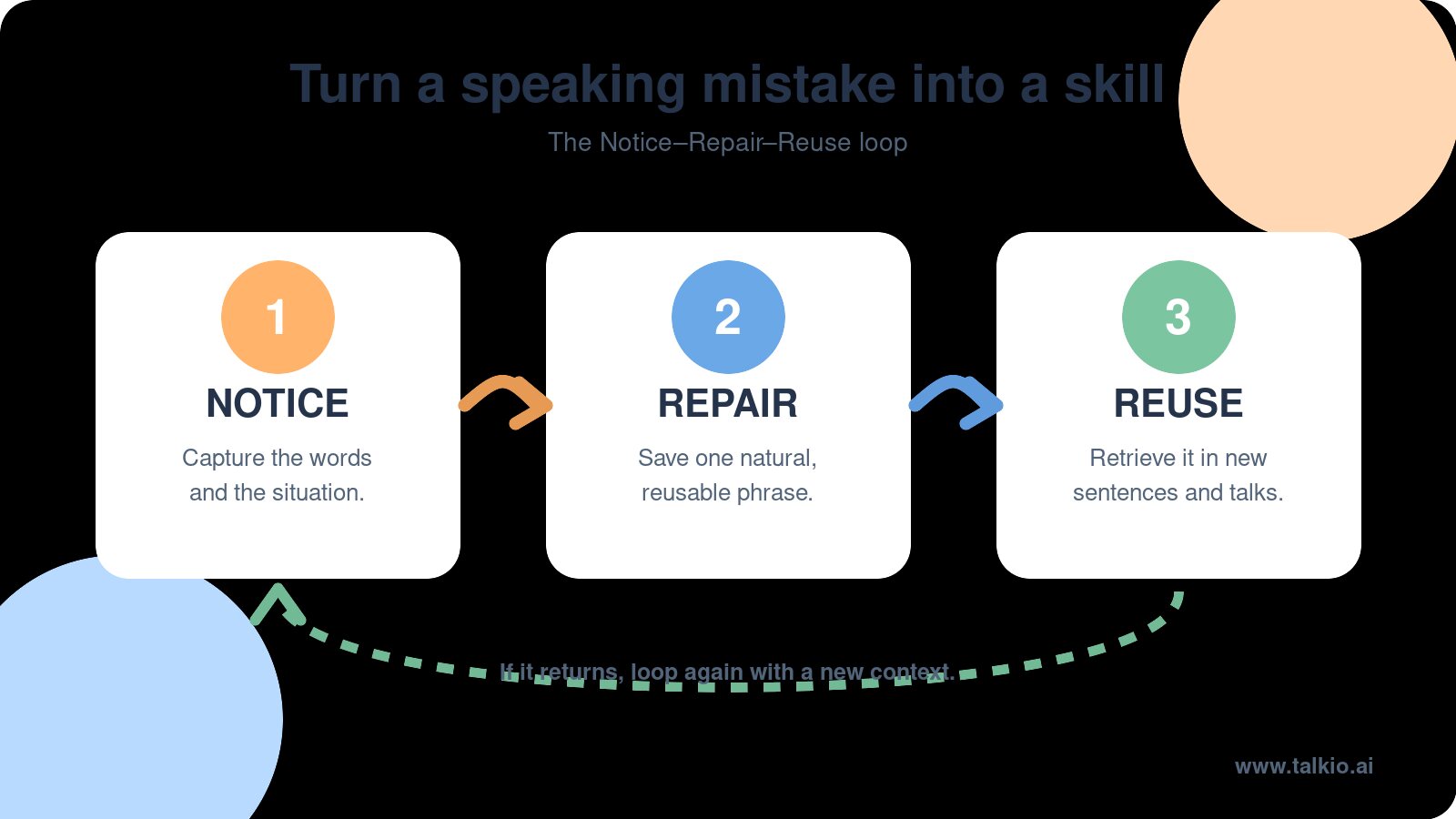
The Notice–Repair–Reuse loop
Use three stages for every item. Each stage answers a different question:
- Notice: What did I actually say, and in what situation?
- Repair: What short, natural phrase should replace it?
- Reuse: In which new sentences and conversations will I retrieve it?
1. Notice the pattern, not your personality
Write the words you used and enough context to make them meaningful. Avoid labels such as “terrible grammar” or “I always fail with tense.” Those judgments are not practice instructions.
For example:
- Situation: explaining a delayed project in a meeting
- I said: “We work on it since Monday.”
- Meaning intended: the work began Monday and continues now
If you did not understand a listener, record the repair phrase you needed as well. Talkio’s list of conversation repair phrases can help you keep the interaction moving instead of pretending you heard everything.
2. Repair it as a reusable chunk
Do not save only an abstract rule such as “present perfect continuous.” Save the sentence frame you want your mouth to find:
- “We’ve been working on it since Monday.”
- “I’ve been waiting for about twenty minutes.”
- “She’s been studying here since January.”
The rule can sit underneath in one short line: have/has been + -ing for an activity that started earlier and continues now. The examples do most of the practical work.
This chunk-first approach complements the method in Stop Studying Single Words. A phrase is easier to retrieve under pressure when its useful neighbours are already attached.
3. Reuse it under gentle pressure
Write three true variations, say them aloud without reading, and then use one in a short roleplay. The roleplay matters because a perfect sentence read from a notebook is not yet spontaneous speech.
For the example above, you could practise:
- Give a 20-second project update.
- Answer one unexpected follow-up question.
- Repeat the update with different dates and activities.
- Return to the same phrase two days later without looking first.
Retrieval is more demanding than rereading, which is precisely why it can strengthen learning. The classic paper on retrieval practice in Science concerns learning more broadly, but its practical lesson fits here: trying to bring knowledge back can be more powerful than another passive review.
A speaking error log that fits on one screen
You need only six fields:
- Date and situation
- What I said
- Better phrase
- One short explanation
- Three personal examples
- Status: new, practising, or retired
Keep no more than five active items. When a sixth arrives, choose: retire an old one, delay the new one, or decide it is not important enough. Scarcity forces useful decisions.
The status field prevents the notebook from becoming a record of permanent defects. An item is supposed to leave. That is also why feedback should be specific and actionable. The Council of Europe’s CEFR resources describe language ability in terms of what a learner can do; your log should point toward a better performance, not merely name what went wrong.
The 12-minute correction workout
Run this sequence two or three times per week. One item is enough.
- Recall for 90 seconds: Hide the repair and try to correct the original sentence from memory.
- Contrast for two minutes: Say the old and new versions once, then stop repeating the error. Explain the difference in simple words.
- Personalise for three minutes: Create three sentences that are true for your life.
- Roleplay for four minutes: Practise a realistic exchange in which the phrase is useful.
- Review for 90 seconds: Note whether the phrase appeared easily, slowly, or only after help.
If speaking alone feels awkward, begin with the warm-up ideas in How to Practice Speaking a Language Alone. An AI conversation partner can also vary the questions and create the mild uncertainty that ordinary flashcards lack.
How to ask an AI tutor for useful corrections
“Correct everything” sounds efficient, but it often creates too much feedback. During a conversation, ask for one target at a time: verb tense, word order, a repeated pronunciation issue, or phrases that caused misunderstanding.
A productive session can follow this pattern:
- Choose one scenario you genuinely need.
- Speak for three to five minutes with limited interruption.
- Ask for the two highest-impact recurring issues.
- Request a natural replacement phrase and two variations.
- Repeat the scenario with one surprise follow-up.
Sometimes immediate interruption is useful, especially when a pattern is frequent and easy to fix. Our article on real-time correction in speaking practice explores that case. At other times, delayed feedback protects the flow of a longer answer. The British Council’s overview of error correction also shows why correction choices depend on the activity and aim.
When should an error leave the log?
Do not wait for perfection. Retire an item when you can:
- produce the corrected pattern on two different days;
- use it in at least two new contexts;
- retrieve it during a conversation or realistic roleplay;
- notice and self-correct quickly if the old form returns.
Move retired items to a monthly review list. If one returns repeatedly, reactivate it with a different set of examples. This is not failure; changing context often reveals that learning was narrower than it seemed.
Weekly checklist: keep the system alive
- □ I have five or fewer active items.
- □ Every item comes from real speaking or a realistic simulation.
- □ Every correction includes a reusable phrase, not only a rule.
- □ My examples are personal and spoken aloud.
- □ I revisit items after a gap instead of drilling them once.
- □ I retire corrections that now appear reliably.
- □ I still spend more time communicating than documenting.
The last point is the safeguard. An error log is support equipment, not the main event. Spend a few minutes repairing what repeatedly gets in your way, then return to conversation. If you want structured speaking practice across realistic situations, explore Talkio’s AI language tutors and use your current log items as targets for the next session.
Your mistakes do not need a bigger archive. They need a shorter route back into speech: notice one, repair it clearly, reuse it in a new situation, and let it leave the list.
Talk Your Way
to Fluency
Talkio is the ultimate language training app that uses AI technology to help you improve your oral language skills!
Try Talkio