
Why Trying to Remember a Word Helps You Learn It
Last updated on
When you meet a new word, the easiest study move is to look at it again. The word feels familiar, so it seems as if you know it. Then you need it in a conversation and nothing comes out.
There is a useful reason for this gap. Seeing an answer and bringing it back from memory are different tasks. Research on retrieval practice suggests that the second task, trying to recall what you learned, can make later recall easier. For a language learner, that means a small pause before checking the answer may be more useful than another quick reread.
This is encouraging because it does not require a longer study session or a special talent for languages. You can add short recall attempts to vocabulary review, listening practice, and conversation. The method is simple, but the details matter.
What retrieval practice means
Retrieval practice is the act of trying to bring information back from memory. If you see the English word “appointment” and try to say the matching word in Spanish, that is retrieval. If you cover the final line of a dialogue and try to complete it aloud, that is retrieval too.
Rereading gives your brain the answer. Retrieval asks your brain to produce it. That effort can strengthen access to the memory, especially when you repeat the process over time and check whether your answer was correct.
A well-known experiment by Jeffrey Karpicke and Henry Roediger used foreign-language word pairs. After learners had produced a word correctly, repeated study did little for delayed recall, while repeated testing had a much larger effect. You can read the study in Science. The result does not mean that study is useless. You first need something to retrieve. It shows why looking at the same list again and again can be less effective than it feels.
The finding also fits a wider body of evidence. A meta-analysis of testing versus restudy found an overall benefit for retrieval practice across many experiments. A separate meta-analysis of practice testing reached a similar conclusion across educational settings and types of material.
Why familiarity can fool you
Suppose you review ten phrases by reading each one five times. By the fifth pass, the phrases look easy. Part of that ease comes from the page, not from your memory. The words are present, and you only have to recognize them.
Conversation removes those clues. You have an idea, but nobody displays the sentence you need. You must find the words, choose a form, and say them quickly enough to keep the exchange moving.
A recall attempt gives you a more honest signal. You either produce the phrase, produce part of it, or discover that you need help. That last result is useful information. It tells you what to review next.
This is one reason a speaking error log can work well. Instead of collecting every mistake, save a small number of words or phrases that you wanted but could not retrieve. They become material for the next practice session.
Use effort, then feedback
Retrieval practice is not a command to struggle without help. If a word is completely new, study it first. If you cannot recall it after a genuine attempt, check the answer. Say it, use it in a short sentence, then try again later.
That difference matters. In experiments on foreign-language vocabulary, the size of the benefit can depend on how well learners encoded the word, how many recall rounds they completed, and whether they received feedback. One study by Toshiya Miyatsu and Mark McDaniel found that limited retrieval practice by itself did not always beat restudy. Combining recall with an effective memory cue worked better in some of their experiments. Their foreign vocabulary study is a useful reminder that a method can be sound without working equally well in every format.
Context matters too. Research on vocabulary learned during reading found that recall opportunities helped compared with a control condition, but rich context could be just as helpful or better when recall success was low. The authors stress the value of feedback and successful retrieval. The study abstract is available on PubMed.
A useful rule is to try, check, and correct. Do not spend a minute repeating a wrong answer or staring at an empty space.
A ten-minute recall routine
Choose six to eight useful phrases from a recent lesson, article, or conversation. Phrases often transfer to speaking more easily than isolated words. If you need ideas for choosing them, read this guide to learning phrases instead of single words.
-
Read each phrase with its meaning and listen to the pronunciation if audio is available.
-
Hide the target-language phrase. Look at the meaning or a simple situation, then say the phrase aloud.
-
Check the answer immediately. Correct the wording and pronunciation rather than accepting something that is almost right.
-
Put difficult phrases back into the set. Leave a little time before trying them again.
-
Finish by using three phrases in your own sentences or in a short spoken story.
The routine should feel demanding but possible. If you miss nearly every item, reduce the set, add a picture or example sentence, and study the phrases once more. If every answer arrives instantly, wait longer before the next review or use the words in a less predictable situation.
Move from cards to conversation
Flashcards are convenient, but your goal is probably not to become good at flashcards. Move the same recall process into speech.
Before a Talkio conversation, pick five phrases connected to the topic. Keep the list hidden while you speak. Try to use each phrase when it fits, without forcing it into every answer. After the conversation, check which phrases you remembered and which ones disappeared under time pressure.
You can also pause before opening a hint. Give yourself a few seconds to complete the thought. If the phrase still does not come, use the help, repeat the corrected version, and continue. This keeps the conversation active without turning every forgotten word into a long interruption.
For fluency practice, tell the same short story more than once. Repetition gives you another chance to retrieve useful language with less hesitation. The 4-3-2 speaking drill offers a clear structure for doing this.
Give the memory time
One successful answer is a good start, not proof that a word will be available next week. Return to it after a delay. A simple schedule might be later the same day, the next day, three days later, and the following week. Adjust the intervals according to your results.
Sleep can also support the consolidation of newly learned vocabulary. It does not replace practice, but it is another reason to stop before a session becomes exhausting. This article on sleep and new vocabulary explains the research and offers a short evening routine.
Do not worry if retrieval feels harder than rereading. The difficulty is partly the point. You are practising the act you will need later: finding language when the answer is no longer in front of you.
Start with one small change
During your next study session, do not replace everything with tests. Choose five useful phrases. Read them carefully, cover them, and try to say them from memory. Check each answer, then use the phrases in a short conversation.
You may remember fewer words than you expected on the first attempt. That is not a verdict on your ability. It is a clearer picture of what is available now, plus a practical way to make those words easier to reach next time.
Sources
- Karpicke and Roediger, The Critical Importance of Retrieval for Learning
- Rowland, The Effect of Testing Versus Restudy on Retention
- Adesope, Trevisan, and Sundararajan, Rethinking the Use of Tests
- Miyatsu and McDaniel, Adding the Keyword Mnemonic to Retrieval Practice
- Vocabulary Learning During Reading: Benefits of Contextual Inferences Versus Retrieval Opportunities
Talk Your Way
to Fluency
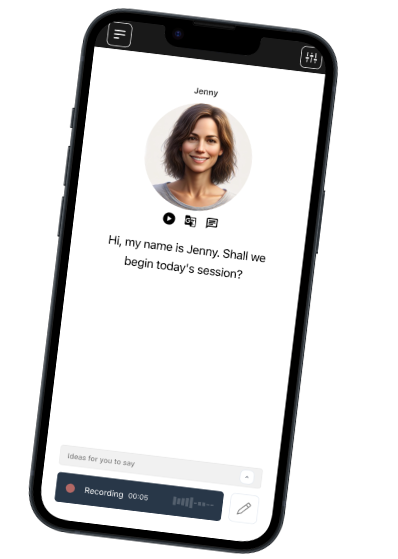
Talkio is the ultimate language training app that uses AI technology to help you improve your oral language skills!
Try Talkio